niedziela, 22 marca 2020

Razorbacks and Bubbletops


Here we have a piece of history of 61 Fighter Squadron from the 2nd half of 1944; aircrafts that never flew all together due to replacement of the planes. This is my favourite UFAAF unit beacuse of presence of so many Polish pilots within the flying personel.


Francis Gabreski, commander of 61FS was son of Polish emigrants who settle down in Oil City USA in early years of XX centrury. Francis (in Polish: Franciszek) baceme a fighter pilot just before breakout of war and was present in Pearl Harbor in the 7th of December 1941. Then he was posted to Europe to raise his fighter abilities where he came across Polish pilots who taken him to their 315 squadron for practice.

Gabreski during fighter practice in 315 Polish Fighter squadron

After practicing in Polish squadron, Gabreski received assignement to 56 FG of  USAAF and after some time bacame a leader of 61 Fighter Squadron. In early 1944 he met his Polish friends again in Northolt airbase. They were all dissapointed due to extent fighter operations far beyond reach of their Spitfires. To satisfy hunting hunger of Poles Gabreski invite some of them as a guests to his 61Fighter Squadron. A few of them stayed there for good.

Polish pilots in 61FS: F/Lt Gładych, S/Ldr Sawicz, Lt Col Gabreski, S/Ldr Rutkowski, F/Lt Andersz, F/Lt Łanowski

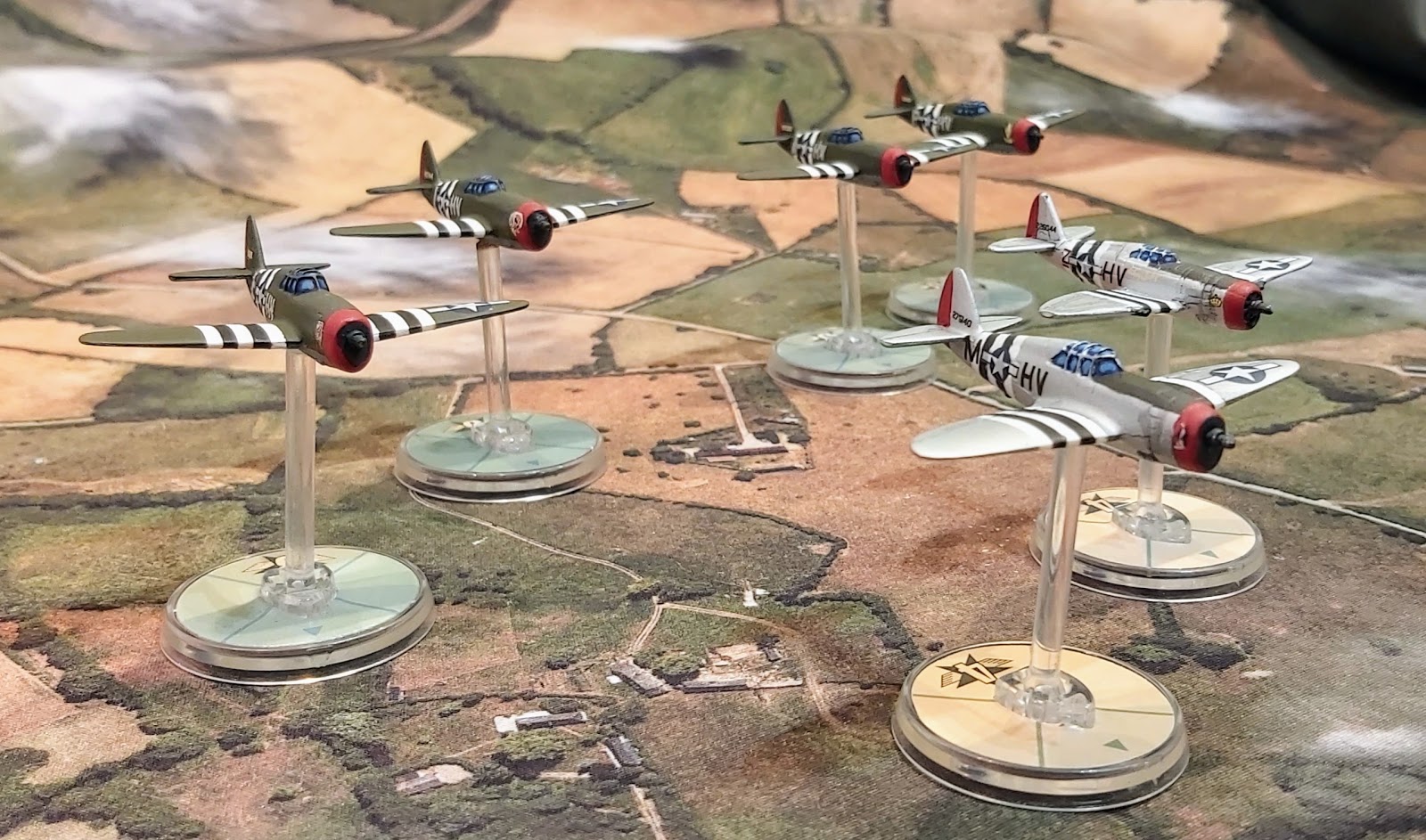
Customarily Gabreski's personal aircraft was marked with "A". Here we have one of his first Razorbacks which was flown in late 1943 and one of the first P47D Bubbletop on which Gabreski crashed in action over Northeast Germany in July 1944. Although his disability Gabreski was top US fighter pilot on the european theatre during 2nd World War. 


F/Lt Bolesław Gładych was one of the Poles who stayed in 61FS for a bit longer. He gains 17 victories 7 flying in Polish squadrons: 302 and 303 and 10 victories in 61FS. This gave him fourth position within Polish aces of WWII.


Each of Głądych's aircraft was named "Pengie" + number. Here we have "Pengie III" Razorback from June 1944 and P47M "Pengie V" from late 1944.


The third well known Polish pilots from 61FS was  F/Lt Witold Łanowski due to his very special personal emblem on his P47M: enormours chequer corresponding to Polish Air Force symbol "szachownica".

F/Lt Łanowski during his duty in 317 Polish fighter squadron

Well known picture of personal Łanowski's P47M Bubbletop


HV-Z Razorback of Leslie Smith (also flown by Gabreski) and HV-Z Bubbletop personal plane of F/Lt Łanowski

A Thunderbolt in Blood Red Skies with "Jug" agility needs very good pilots (Polish veterans and Gabreski as an ace will be a good choice). I was learned that during first dogfight against "Gustavs" been beaten to Zero. Next time I will be wiser for sure.



czwartek, 19 marca 2020

National traits


Having more and more Blood Red Skies airplane cards in my collection I saw some regularities in their characteristic. There are some specific traits that are typical for particular nationalities. Though subsidiary traits could change the core oneremain unchanged.

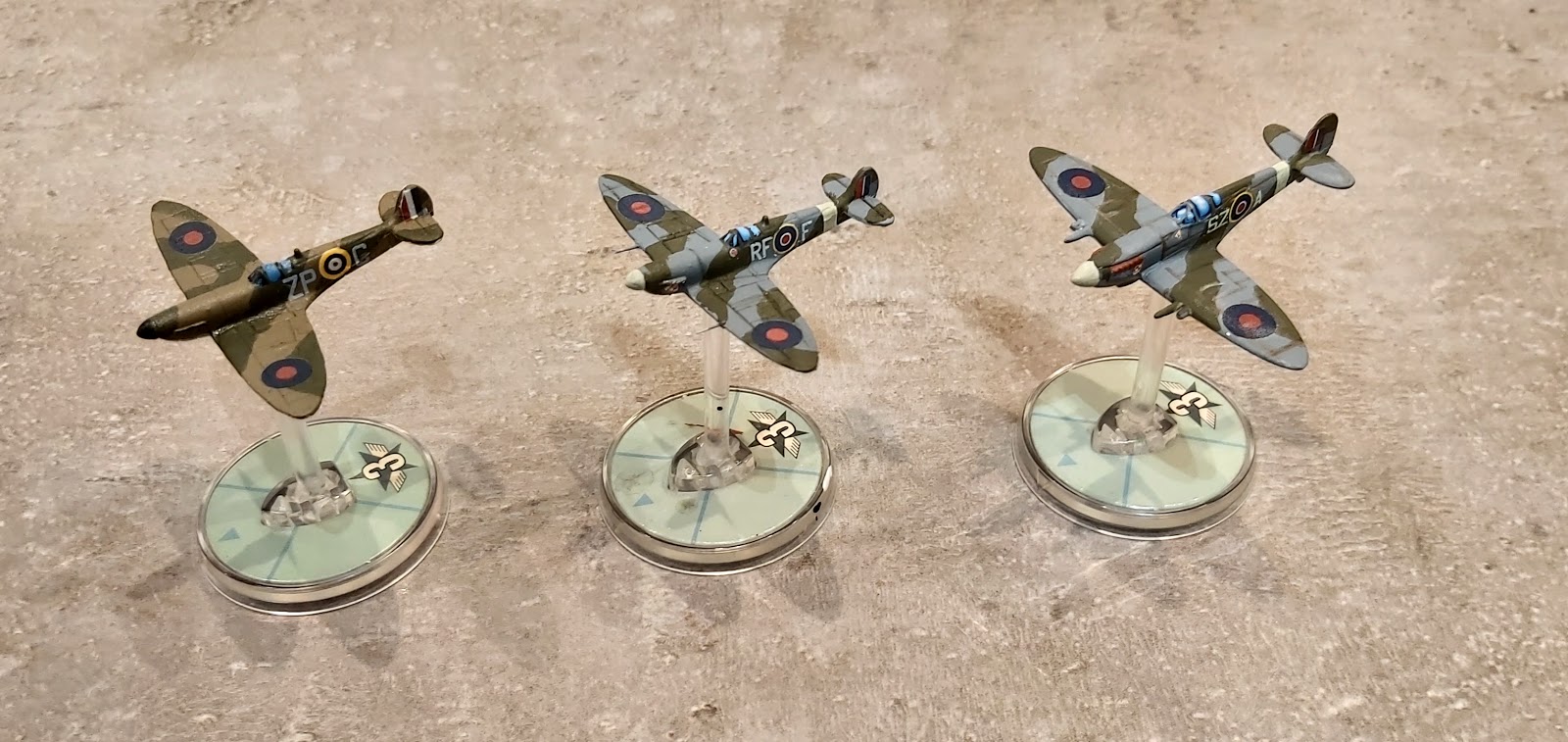
British - a snake

Typical British Fighter: Supermarine Spitfire is Agile as a snake. Getting into horizontal fight with him is a suicide. Though the later versions bacame faster, better armed, this fighter keeps a abilities of snake.


German - a falcon

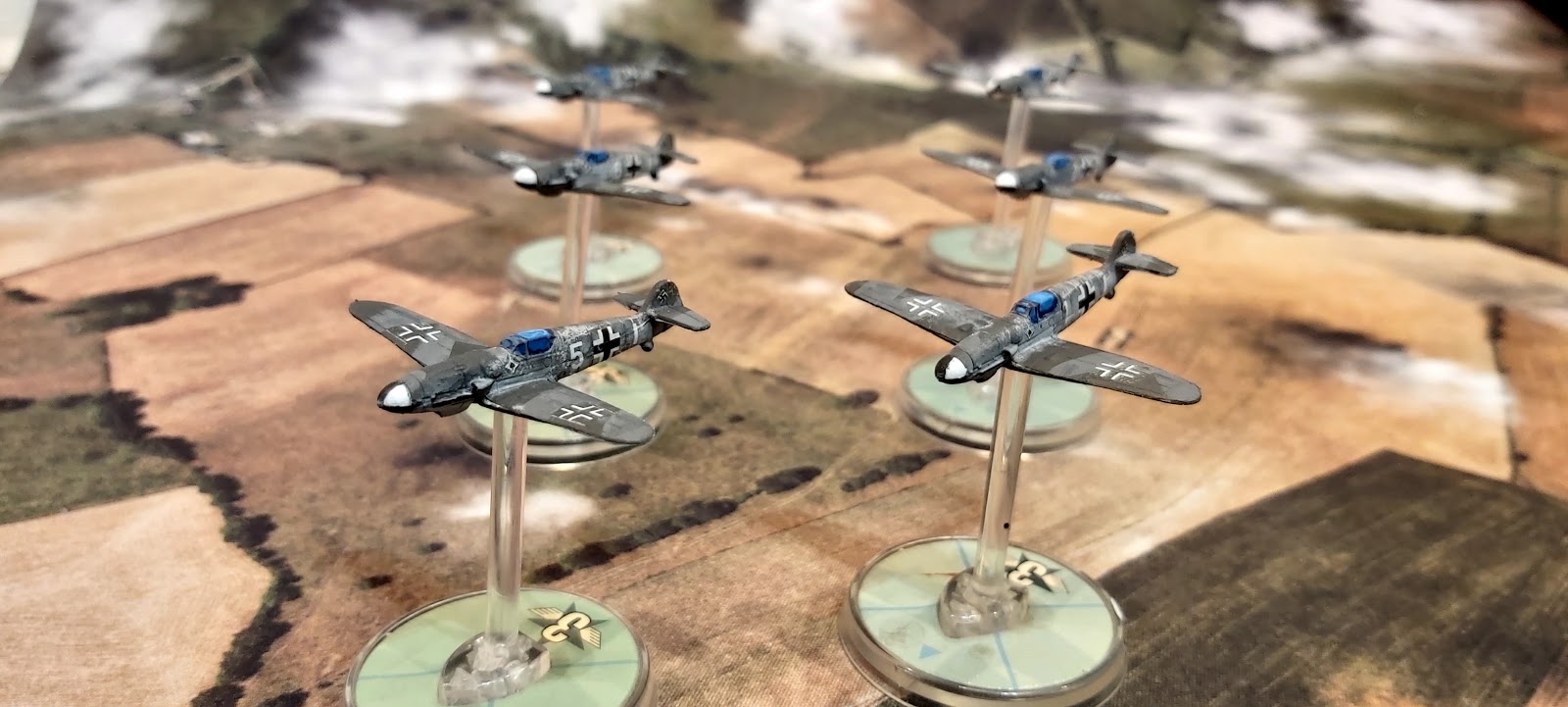
Each Bf-109 starting with Emil and ending with Gustav can climb high and suddenly dive for a prey as a falcon. Easy climbing and diving are their immanent atribute. Each subsequent Messerschmitt 109 is faster than predecessor - what is obvious - and less agile but stays falcon in the heart.


American - a Rhino

The immanent atribute of American fighters (which is not connected with any particular brand) is solid construction giving them enormous ability to stay in the air and strong - and growing - armament. Each subsequent American fighter is faster, better diving aircraft but still with rhino agility.

/


sobota, 14 marca 2020

Bf109G - Third level of evolution


Gustav is a bit faster than Friedrich, better armed and less agile than the both predecessors but still he is a part of Messerschmitt family: Great Divers and  Great Climbers.


Bf109G is a part of new line Warlord games resin models for Blood Red Skies. I have to say that switching to a resin was a good decision from the players perspective. New resin models are quite well casted with many details and ... you do not need to weight your bases anymore :).


My Gustavs were painted with a standard camo RLM 74/75/76 with a Hataka range paints. For decoration I have used miscmini dedicated decal set..


czwartek, 12 marca 2020

P40E - natural born Shark


P40 without shark mouth is only half of P40. I was happy to hear that Warlord is going to publish resin model of P40 for Blood Red Skies. That gives me a chance to ... use in a battle my Armament in Miniature's models of Kittyhawk I bought before. There was also a chance to compare Warlord and AiM miniatures.

Fortunately there is a good selection of decals for this plane in 1/200 (at least two positions, both by Miscmini and none by Warlord!). I was hasitate between AVG markings from China (where mjr. Urbanowicz fought against Japaneese on P40M) and 112 RAF squadron from Africa.
Finally I had chosen desert markings of 112RAF squadron for few reasons: Firstly - each of 6 shark smiles is different, secondly: Urbanowicz fought in China on P40M in 1943, (when the aircraft markings were USAAF rather than Chinese) and last but not least: there were Polish pilots practiced on P40E in 112 RAF squadron.


Kittyhawk squadron begins a new Operational Theatre project: Africa (I definiatly need another playmat for it).


It is not easy to see the differences between AiM and Warlord Kittyhawk models. Both have more or less correct dimensions, AiM with a bit more slim fuselage. Warlord model is better detailed (more panel lines, nice cast air grip). Unfortunately Warlord's resin quality is not as good as David's from AiM. On the other hand the higher cost of transport from US convince me to Warlord model, but AiM have very wide offer, very hard to resist.


Kittyhawk in play is a typical US fighter: heavy armed, robust not very agile plane (as well as Wildcat, Corsair or Thunderbolt). I'm looking forward to try it against Friedrich (a typical German fighter), or during straffing missions. I'll keep you posted!


sobota, 29 lutego 2020

Me-262 - Blood Red Skies


 Game changer in the Blood Red Skies, too fast for every opponent. Does it perform well in the dogfight? I could say a comment in a few days. The only thing I'd like to say is that it need a proper target: heavy Allied bomber. The launch of B-17 model seems to be crucial for the Blood dRed Skies game.


Schwalbe was my very first resin plane from Warlord. After rather difficult experiences with metal models I was rather skeptical, but now I have to say that the company have done good job. The cast is clean, the panel lines are clear and thin, so the final effect is satisfying. The only remark for Walord's plane sets is lack of model dedicated decals (only generic markings are added)


This model is unique also for another reason. Due to smooth transition of colours on the German camo I decided to paint Schwalbe with an airbrush and I have to say that I'm happy with an effect. For a painting I have used Hataka range colours, decals are from miscmini range. What do you think?


poniedziałek, 24 lutego 2020

Typhoon Mk I - Blood Red Skies


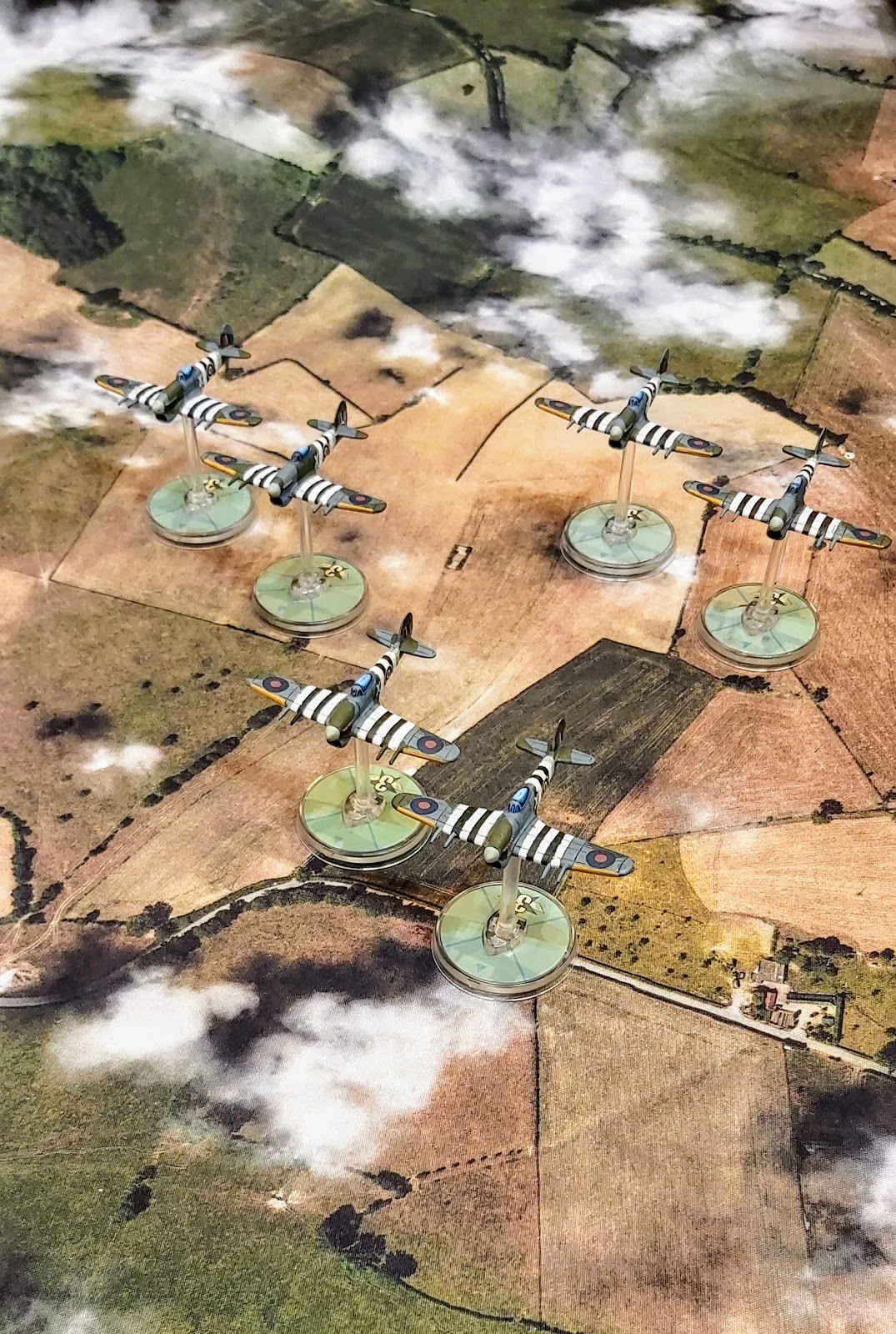
I must confess: I love invasion stripes. That's why I decided to buy a couple of Typhoons to make them black and white. Even though the Polish squadrons have never used them during WWII. 

But this project was on hold for a long time. Although I have a Typhoon stats card from British expansion pack I put them for the long rest into my To-Do box. The things have changed when the Airstrike premiere was announced. After reading an Airstrike supplement book the work was speeded up. Now I have my first fighter-bomber squadron ready to Strike from the Air the German positions in Normandy. A chance for jont game of Bolt Acion and Blood Red Skies is going to appear soon in our local wargame club.


Typhoons models are from Armament in Miniature range, decals of 174 RAF squadron by Miscmini, models painted with Hataka RAF dedicated paints, invasion stripes painted with an airbrush using masking tape. 


czwartek, 6 lutego 2020

P47 - unboxing


Just received my copy of P47 by Warlord Games (in fact others too) and I have to say that I'm really impressed. The model looks really good. The quality of Warlord's resin cast is great. We have plenty of details (including engine), set of delicate panel lines on wings and fuselage, and only few mouldings on the sides. Additionally last but not least it stands straight on the original BRS stand. 


Having similar model by AiM I could compare them. See below the pictures (Dark Grey: Warlord Games, White: AiM).


Looking at the stats I can say that P47 is a kind of faster and better armed Wildcat with limited agility. Hopefully it is faster (a bit ) to Fw190 and similarly Robust.
At last I have a stats of my favourite fighter and I can unleash the great firepower of Jugs. 


P47D25 - Armaments in Miniature


środa, 5 lutego 2020

Sidi Rezegh 1941 - Scenariusz


Operacja Crusader

Pierwsza połowa roku 1941 w Afryce północnej upłynęła pod znakiem wzmożonej aktywności wojsk Osi. Wzmocnienie sił włoskich przez niemiecki korpus afrykański pod dowództwem gen Rommla umożliwiło wyprowadzenie śmiałej ofensywy, dzięki której front przesunął się setki kilometrów na wschód w kierunku Egiptu. Twierdza Tobruk została zablokowana i wojska Osi podejmowały kolejne próby jej zdobycia.
Zadanie deblokady twierdzy powierzono dowódcy nowo utworzonej 8 Armii gen. Cunninghmamowi. Operacja o kryptonimie Crusader rozpoczęła się 18 listopada 1941. Główną siłą uderzeniową był brytyjski XXXKA, który miał za zadanie obchodząc pozycje Osi pobić niemieckie jednostki pancerne i dotrzeć w okolice twierdzy Tobruk celem jej odblokowania. Jednocześnie obrońcy Tobruku mieli angażować oblegających aby ułatwić zadanie wojskom zmierzającym z odsieczą.
Na tyłach wojsk Osi działały jednostki LRDG, które miały na celu dezorganizację strefy tyłowej ze szczególnym uwzględnieniem składów zaopatrzenia i lotnisk.
Czy wojskom brytyjskim uda się poprawić swoją sytuację strategiczną w Afryce i zdobyć Tobruk? O tym będą mogli przekonać się gracze wcielając się w rolę dowódców jednostek biorących udział w tej operacji.

Zasady Specjalne:

Dominacja Luftwaffe: na przyfrontowym lotnisku el Adem stacjonują lotnicze siły uderzeniowe Osi, które pozwalają na permanentne wsparcie lotnicze . Oznacza to, że po zutylizowaniu wsparcia FAO może wezwać kolejny nalot.

Mapa Sidi Rezegh

Sidi Rezegh to obszar pustynny z elementami osady, większymi i mniejszymi skałkami, częściowo pokryty roślinnością.


Siły stron:  Stroną atakującą są Alianci, a wojska Osi są w obronie. Obrońca rozstawia połowę swoich wojsk zaokrąglając w dół na planszy, pozostałe (w tym wszystkie pojazdy znajdują się w rezerwie i są dostępne od 3 tury. Atakujący wprowadza swoje siły w First Wave. Nie działa outflank, działa forward deployment, Atakujący ma Preparatory Bombardment na 2+.  

Cel gry: Celem atakującego jest wyprowadzenie jak największej liczby oddziałów przez wrogą krawędź mapy. Za każdy wyprowadzony oddział Atakujący otrzymuje 2PZ, za każdy oddział pozostający po zakończeniu ostatniej 7 tury w strefie przeciwnika (6 cali od krawędzi) gracz otrzymuje 1PZ. Za każdy zniszczony oddział przeciwnika wojska Osi otrzymując 2PZ.